
-
 CN
CN
-

-
Free nationwide
Consulting hotline
151-6566-1555
CN
Free nationwide
Consulting hotline

 Anaerobic reaction equipment
 151-6566-1555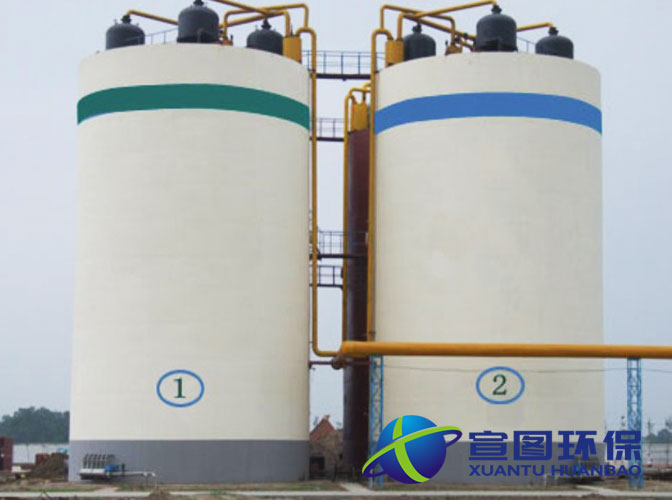
产品详情
Product overview:
EGSB anaerobic reactor is the third generation anaerobic reactor, which is an improved version of UASB reactor. Compared with UASB reactor, the difference between EGSB reactor and UASB reactor is that the rising flow rate of liquid in the reactor is different.
In UASB reactor, the hydraulic rising flow rate is generally less than 1m/h, and the sludge bed is more like a static bed, while EGSB reactor can generally reach 5-10 m/h by adopting effluent circulation, so the whole granular sludge bed is swollen.
EGSB was optimized to solve the problem of sludge loss under high hydraulic load and gas agitation. At present, EGSB reactor can treat pharmaceutical, chemical, biochemical and biological engineering industrial wastewater at high organic load (up to 30kgCOD/m3. d), as well as toxic wastewater at low temperature (≥ 10 ℃) and low concentration (≥ 1000mgCOD/L).
Working principle:
EGSB reactor is an upflow reactor, generally cylindrical tower, characterized by a large height diameter ratio, generally up to 3~5, and the reactor height of the production unit can reach 15~20 meters.
EGSB reactor can be divided into inlet water distribution system, outlet water return system, reaction zone, three-phase separation zone and outlet channel system. The wastewater is evenly distributed to the bottom of the whole reactor through the influent distribution system, generating a uniform upward flow rate, and then the organic matter is converted into biogas through the anaerobic granular sludge bed. Sludge particles, biogas and effluent are separated in the three-phase separator at the top.
The treated water flows out from the outlet tank, the biogas is discharged from the biogas pipeline, and the granular sludge returns to the granular sludge expansion bed. Compared with UASB reactor, EGSB reactor requires less water distribution area due to its larger height diameter ratio; At the same time, the outlet water circulation is adopted, and the flow rate of its water distribution orifice will be larger, so the system is easier to ensure uniform water distribution.
The three-phase separator is still the key structure of the EGSB reactor. Its main function is to effectively separate the effluent, biogas and sludge, so that the sludge can be effectively retained in the reactor. The process has higher hydraulic load than UASB reactor due to three-phase separator.
Technical advantages:
(1) EGSB can achieve high processing efficiency under high load. When treating wastewater with COD lower than 1000mg/L, the waste water has high load and removal rate. Especially at low temperature, the treatment of low concentration organic wastewater can also achieve good removal effect.
(2) Maintain high rising flow rate in EGSB reactor. In UASB, the rising velocity of liquid flow * * is only 1m/h, while that of EGSB can be as high as 3~10m/h (* 15m/h high). Therefore, the structure of slender reactor with large height diameter (15~40) can be used to effectively reduce the floor area.
(3) The granular sludge bed of EGSB is in an expanded state, and the granular sludge has good performance. Under the condition of high hydraulic load, the particle size of the granular sludge is 3~4mm, the agglomeration and sedimentation performance is good (the particle settling speed can reach 60~80m/h), and the mechanical degree is also high (3.2 × 10⁴N/m2)。
(4) EGSB uses treated effluent reflux. For low temperature and low load organic wastewater, reflux can increase the mixing degree of the reactor, ensure a good mass transfer process, and ensure the treatment effect. For organic wastewater with high concentration or toxic substances, the concentration of matrix and toxic substances entering the reactor shall be diluted by reflux to reduce its toxicity to microorganisms.


 在线咨询
在线咨询